Wednesday, June 17th, 2009
My second after college, being all adult-like from 8-5 job, anyway.
This place is much smaller than my first after college job. I will, after many mistakes and requests to remind me again, learn every developer’s name, and those of the QAs and BAs too. People say hi in the maze of hallways more. It’s a bit chaotic (why is this person’s name on this ticket?). There’s no documentation to speak of. I could really, really use a data structure map of the main databases.
My work wardrobe is a notch too dressy for this place, and two or three notches too warm. But I won’t complain about getting to wear jeans any day of the week. As a result of some business partnership, we are called leased-employees in the handbook, which strikes me as one of the worst names they could have chosen. It feels really weird to being driving to work. All these stoplights, waiting, without being able to read or zone out. At least parking is free.
I’m just thrilled to be in a bunch of actual developers. Everyone speaks the same language, and I have people to ask questions of. (A lot of questions right now.) I don’t know enough to be useful yet, but I feel a lot less deer-in-the-headlights this time around, and more confident about asking the stupid questions now in order to bring me up to speed faster than silently hoping that I’ll find the needed clue, eventually. It felt like college had pretty much nothing to do with what my first job ended up requiring in the navigation of business speak and process (or really any of the work I actually did, for that matter). Knowing some of the business speak now is certainly useful, but there is so much less artificial process and rule making here, where you have to interface with several other departments to get anything done, who all scrutinize why you need access, redirect you to get someone else’s stamp of approval. Not that good communication and consistency are bad practices, and are indeed what business processes are supposed to enforce, but I get the feeling here that if you have the time and ability to get something done, people here would love that you have volunteered, and let you have at it. It’s refreshing. And I’m enjoying my blissful optimism before I get to digging deep into whatever bad practices or choices that inevitably have been made here just like every other organization.
Sunday, June 7th, 2009
I thought last year that four tomato plants (five once the volunteer Roma got going) might be too much for the two of us. It’s really hard to have too many roasted tomatoes, though. With two or three more plants, we would probably have needed to start using them in more ways, making our own spaghetti sauce maybe. The two we have now, though nice for garnishing salads and breakfast eggenues (*sigh* I miss Avenue Bread), don’t produce enough to cook with very much.
We picked everything near red to make our first batch of roasted tomatoes, currently in the oven.
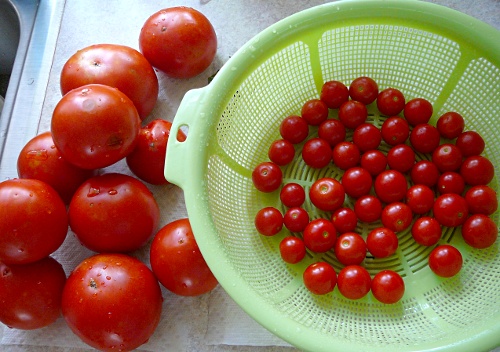
Though we do not have blossom end rot, like last year, the tomato plants aren’t looking the greatest. We lost a couple of fruits to cracking and then bugs getting inside.
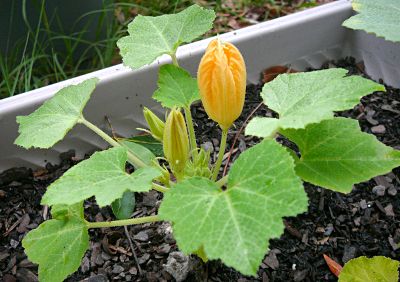
The yellow summer squash tried to bloom again last week, still with tiny, unhappy leaves. This week, all three squash plants are pretty much dead.
Saturday, May 30th, 2009
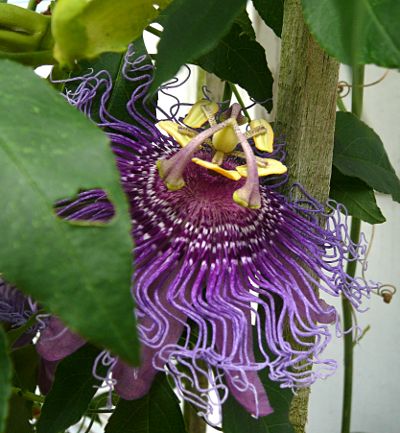
I got Mike this passion flower vine:
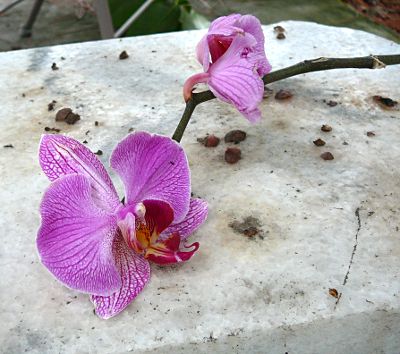
And then Mike got me these:

Meanwhile, there’s an orchid growing, no help from us, with a tree in a pot outside. The debris are acorn remnants from the squirrels.
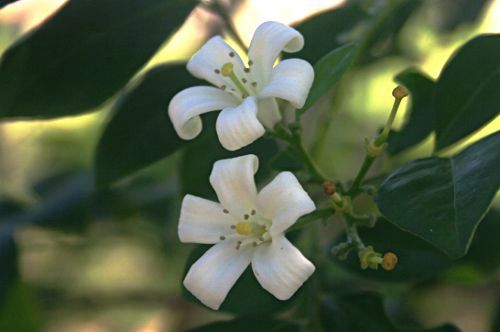
I haven’t been able to identify this flower out by our front gate. It smells a bit like gardenia, but obviously the petals look completely different.
Monday, May 25th, 2009
So Florida has been in this long drought. Not Murray-Darling Basin dry, but unenforced rationing of lawn watering dry. Since the 13th, however, we’ve gotten 5.86″ of rain at the airport. The average for all of May is 2.74″. It’s brought out the frogs and the rain lilies and what grass there is in the lawn is growing like mad.
This nifty drought map notes that in the last week we’ve gone from 57% of Florida being in Severe or Extreme drought down to 31.5%. Tampa Bay is now colored yellow for Abnormally Dry (least serious category). It would be nicer if the downpour was spread out more of course.
With the rain often comes lightning. Wunderground’s animated radar has become my favorite website, watching for when we may need to unplug the computers in case of power surges.
These clouds are from the 16th.
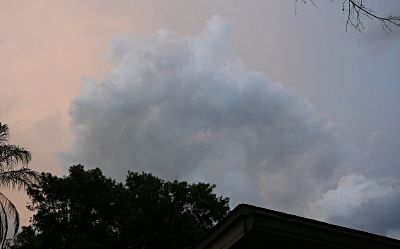
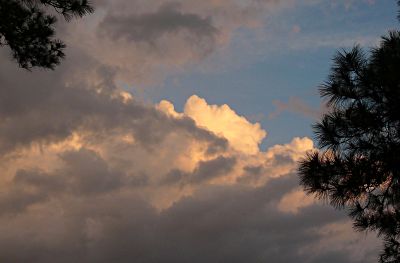
The lightning here reminds me of Kilauea: a force of nature that you must adjust your life for. The consequences of trivializing either can be immediate and severe. I’d like to think that such reminders of our fragility would lead to a general respect for the balance of all the rest of the system. But reading the reality of the changing winds is as difficult for recording industry heads as it is for workers of the land.
From the Murray-Darling Basin article:
What Jones [a fisherman] finds, as he travels around the basin to argue that water must be allocated for his Coorong [national park and lagoon ecosystem] and his lakes, is a sentiment that the whole water crisis is the environmentalists’ fault anyway. The greenies are derided for their shrill sanctimony. Farmers express indignation that any of their precious “working river” is lost to the sea. They tell Jones that it makes more sense to divert the Murray all the way inland, officially consigning the river to eternal servitude as an irrigation channel, while fishermen buck up and learn to live off the sea. In cotton-growing areas wholly dependent on irrigation, Jones says, “I’m lucky to get out with my life.”
And from another National Geographic article about the Tongass National Forest in Alaska:
a former logger and millwright, Bob Widmyer… said, “They decided they had to save all the trees and shut down the mill, and everybody here and in Ketchikan started to starve.” The Widmyers ended up at a culinary arts school in Arizona. They were back in Alaska now, and he operated a commercial fishing boat. “I’m kinda bitter,” he told me. “This is a damn rain forest. It was put here to log.”
Some blamed environmental activists and the Timber Reform Act for throwing people out of work, but others argued that the mill closures had more to do with a sharp recession in Japan, a slumping world market for pulp, and Alaska’s disadvantage in competing against countries with faster growing trees and less expensive pulp production methods. Ketchikan’s mill was also facing serious air- and water-pollution fines.
I get that each one of these farmers and loggers are being faced with the loss of their investments and livelihoods, and that in both of these examples, the government was formerly encouraging the consumption of the very natural resources that are now being withheld. These groups have an interest in the present moment to continue to reap the land as they’ve built a history of doing, but their stubborn disregard for their own future viability as well as other people’s, let alone the health of parts of ecosystems that aren’t obviously involved with someone’s occupation, is stunning. The rain forest wasn’t put here for you to log any more than it was put here to protect the salmon spawning beds, and attempting to grow rice in a desert, though possible, for a while, was never a good idea.
Thursday, May 21st, 2009
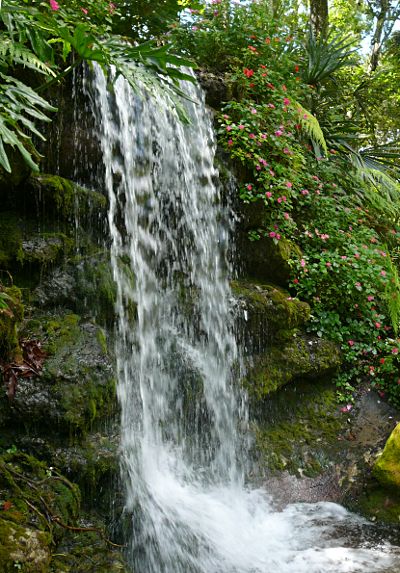
Florida, being rather flat (though there are some pleasant, rolling mini hills), does not have raging rivers, or, usually, waterfalls. So here I was, excited to see the promised waterfalls at the headsprings. It turns out they are man-made. The pumps that raise the water from the springs are turned off at night.
From the park’s website:
In the 1930s the spring was developed as a tourist attraction. Sea walls, a lodge, gift shop, the waterfalls, and a reptile exhibit were developed…. Under new ownership, the real heyday for the attraction occurred in the 1960s. During that time, activity greatly increased with glass-bottomed boat rides, riverboat rides, a log raft ride, a gift shop and cafe, an aviary, a leaf-shaped gondola/ monorail system, a rodeo, and submarine boat tours. When I-75 was built however, traffic was diverted away from this area and tourists began heading to a new attraction called Disney World.
About the only thing that interests me in that list is the submarine boat tours, and thankfully much of the rides are now gone (you can still rent canoes and such). However, I still think it works out better if you show up with the expectation that you are going to a park rather than a wilderness. That will also brace you for the crowds. It actually reminded me quite a bit of the Japanese Gardens in Manito Park, with the paved pathways and conveniently located benches, minus the air of quiet contemplation.
There’s a swimming area, which was my main reason for wanting to visit, but by 10am on Sunday it was starting to fill with screaming teenagers, splashing around with their floaty noodle things. The roped off area was pretty small, anyway.
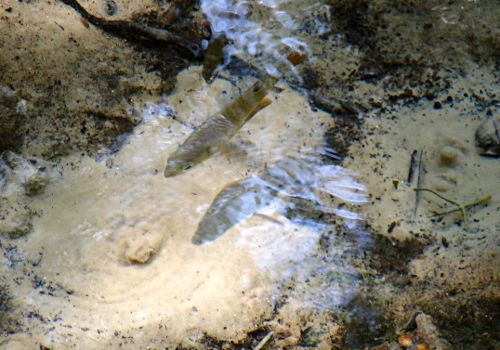
So more picture taking was done instead. Water is bubbling up through the sand from the two cleared away spots under this sunfish:
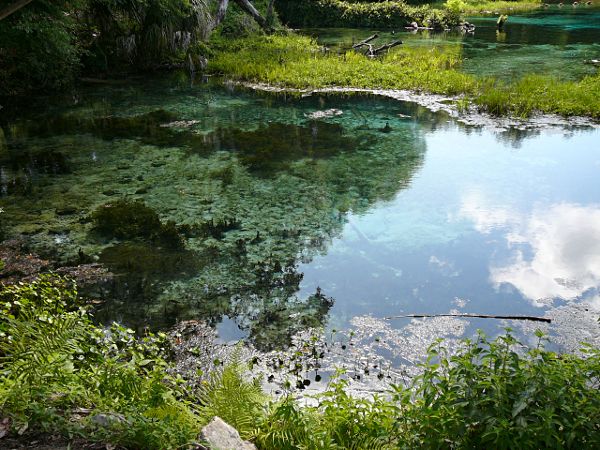
Springs is very much plural here. This is a different spot than the picture above:
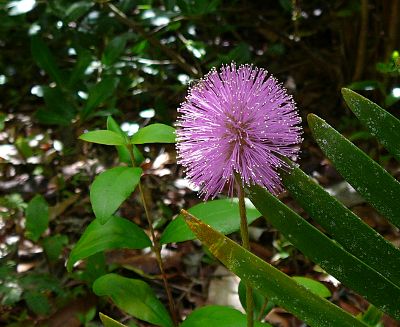
This delightful fiber optic starburst like flower is mimosa strigillosa:
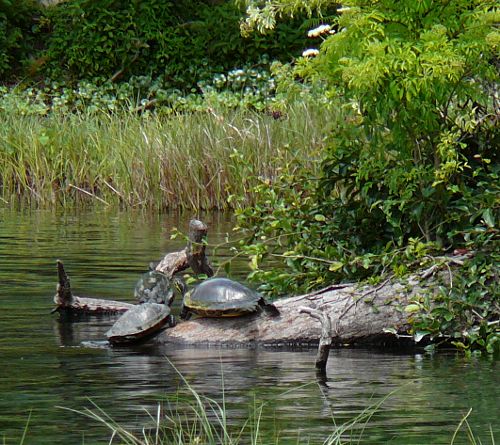
We saw several turtles. I’m still working on identifying them.
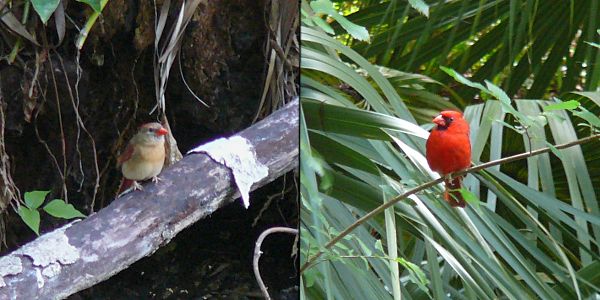
We have cardinals and blue jays in our neighborhood as well, but they flit around so much, it’s hard to get pictures of them. These at the park are the best I’ve gotten so far.
And finally, if you were wondering, McDonalds has not improved the quality of their food while you were abstaining from their food-product offerings.
Tuesday, May 12th, 2009
Celebrate! We have picked our first tomatoes! As it turns out, the cherry tomatoes are a bit quicker to ripen once they start to turn than the bush goliath. Picked on Sunday, we each tried one of the cherries this afternoon.
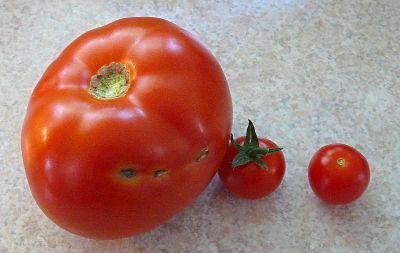
This means that a ripe tomato was had 46 days from first fruiting on the bush goliath, and 34 days for the husky cherry red. This isn’t comparable to the durations listed below, as values are for the rather fuzzy days from planting outside until harvest. The bush goliath seems more sensitive to heat/dryness, as even after we moved it into the shade, it still wilts faster than the husky cherry red.



